Earth Sciences146
-
Welcome to the LARISSA Cruise!
Right now, everyone is busy working in port. There is cargo to load, labs to set up, and endless problems to solve. But it will all be worth it once we set sail on January 2nd. Here’s the Research Vessel Nathaniel B. Palmer, otherwise known as the NBP And here’s cargo being moved to one…
-
This Time, A Colder Destination
My name is Debra Tillinger and I’m a graduate student in ocean and climate physics at Lamont-Doherty Earth Observatory. Until now, all of my work has focused on the tropics. My thesis is about the Indonesian Thoroughflow, which transports water from the Pacific Ocean to the Indian Ocean via the narrow straits and deep basins…
-
Return to an Ice Shelf Lost
A team of scientists, technicians and helicopter pilots will sail from Punta Arenas, Chile, for Antarctica on Jan. 2. I’ll be part of that team, collecting data, and serving as co-chief scientist for the cruise. Our home for the next two months will be the ice-breaking research vessel Nathanial B. Palmer. My journey starts with…
-
Christmas at Sea
As you know yesterday was Christmas, and things are just a little bit different on such a holiday aboard a research vessel. Although the sub was in the water, many of the crew had the day off. As far as I can tell, most of them work around the clock, so such a rest was…
-
But Time Will Not
Not everything on a research vessel always goes according to plan. Today we awoke to find out that during the night the primary CTD winch failed, leaving about 2000 meters of cable and a large instrument package over the side. Alvin cannot dive when we have a wire in the water, so this situation is…
-
A Light in the Darkness
After a search during dive 4576, Scott finally found a suitable site for the VentCam deployment, and later that evening we launched the system overboard for its first trip to the seafloor. The next day, with the help of pilot Bruce Strickrott and pilot-in-training Anton Zafereo, we dove in Alvin to recover the device and…
-
And the Work Begins
Monika Bright of the University of Vienna had the first dive of the expedition yesterday and brought back with her all sorts of squishies both tiny and small from sites of diffuse venting around the high-temperature hydrothermal vents far below the ship. Being that I am a geophysicist, I don’t fully understand all the biological-type…
-
Gumby Suits
The first day of any UNOLS cruise is filled with myriad meetings, briefings, and safety courses. All new crew members and scientists are provided a comprehensive orientation to introduce them to many of the ships operations, safety equipment, and procedures. Among other things, we learn about separating our plastics from the biodegradable trash, what kind…
-
Journey to the EPR
Yesterday we set sail from Manzanillo, Mexico, bound for a hydrothermal vent system on the East Pacific Rise (EPR) near 10 degrees North. The EPR is part of the world’s mid-ocean ridge system where new crust is formed as Earth’s plates spread apart. Many of the most exciting Earth processes occur at mid-ocean ridges, including…
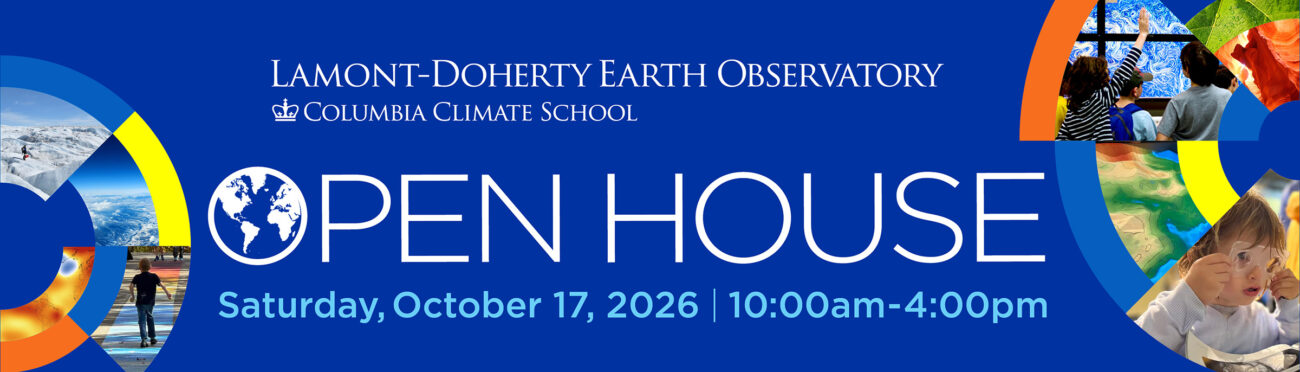
On Saturday, October 17, 2026 from 10am to 4pm, Lamont-Doherty Earth Observatory Open House—our biggest, best science fun and discovery event of the year—will take place on our beautiful campus in Palisades, NY. Mark your calendar and join us for this free, family-friendly celebration of science! RSVP Today!