Earth Sciences70
-
Day 2: What Am I Doing Here, Anyway?
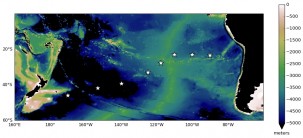
The South Pacific Gyre is the most nutrient-poor region in the ocean, and the waters are the clearest in the ocean. The sediments accumulate below the water at rates as low as 0.1 millimeter per thousand years. So, 10 centimeters of seafloor are equivalent to one million years of material deposition in the South Pacific.
-

Detecting Landslides from a Few Seismic Wiggles
Over the last six years, seismologists Göran Ekström and Colin Stark have been perfecting a technique for picking out the seismic signature of large landslides. They just discovered North America’s largest known landslide in many years – 200 million tons of sliding rock in Alaska.
-

Setting Sail? Plan for the Unexpected
In the weeks before departing for my first scientific cruise, everyone I knew who had ever been to sea gave me some form of the same advice: Nothing ever works the way you expect it to work at sea.
-

Testing the Speed of Lava: What It Says about Escape Times & Mars
Elise Rumpf’s lava flow simulations are yielding new details about the velocity of lava over different surfaces. They may also hold clues about the surfaces of other planets.
-

Catch Up on the Latest in Earth Science with AGU Sessions Live Online
The American Geophysical Union’s Fall Meeting opens in San Francisco this week. Catch up on your interests through AGU’s On-Demand live stream.
-

Using LiDAR to Shine a Light on Ross Ice Shelf
LiDar (Light Detection and Ranging) is a remote sensing technique that uses light to develop an elevation image of the surface of the Earth. It is sensitive enough to image small items such as seals lying on the ice surface.
-

Greenland Glaciers Retreating Faster than Any Time in Past 9,500 Years
A new study uses sediment cores to track the expansion and retreat of glaciers through time, and finds that they are retreating quickly and are more sensitive to temperature change than previously realized.
-

American Geophysical Union 2015: Key Earth Institute Events
Scientists at Columbia University’s Earth Institute will present important findings at the American Geophysical Union fall 2015 meeting, Dec. 14-18–the world’s largest gathering of earth and space scientists.
-

The Compact Efficiency of New Airborne Science
The latest team celebration is around the magnetometer data. Magnetics has evolved quite a bit over the years of geophysical sampling. Lamont scientist Robin Bell recalls when in the 1990s working on a project in West Antarctica that the magnetometer was towed on a winch ~100 meters behind the aircraft – now it is nearly…


On Saturday, October 17, 2026 from 10am to 4pm, Lamont-Doherty Earth Observatory Open House—our biggest, best science fun and discovery event of the year—will take place on our beautiful campus in Palisades, NY. Mark your calendar and join us for this free, family-friendly celebration of science! RSVP Today!
