State of the Planet

News from the Columbia Climate School

education24

  • Master of It All: One Woman Scientist Pays Tribute to Another

    Master of It All: One Woman Scientist Pays Tribute to Another

    Lamont-Doherty geophysicist Robin Bell pays tribute to colleague Kim Kastens who is retiring from Lamont after 31 years. Kastens was the first woman co-chief scientist on the JOIDES Resolution, first woman faculty member to join Columbia’s geology department, founder of Columbia’s joint journalism and environmental science master’s program and a pioneer in the field of…

  • Polar Climate Change Education Partnership Receives $5.6 Million Grant

    Polar Climate Change Education Partnership Receives $5.6 Million Grant

    The Columbia Climate Center led PoLAR Climate Change Education Partnership receives a $5.6 million grant from the National Science Foundation (NSF), one of six awards under the Climate Change Education Partnership-Phase II program.

  • Education for Sustainable Citizenship

    Education for Sustainable Citizenship

    UNESCO Director General Irena Bokova said sustainable development cannot be achieved by political agreements, financial incentives or technological solutions alone. There must be a fundamental change in the ways individuals think and act.

  • Students. Saturday. Science?

    It’s a Saturday morning, and most kids between the ages of 12 and 14 are sleeping in, off to rehearsals or sports team practice, or grudgingly helping with household chores. At Columbia University, a group of middle-school students are eagerly engaging in the scientific method.

  • From Brazil to Jordan: Columbia Undergrads Learn about SEE-U’s Summer Fieldwork Programs

    Undergraduate students learn about summer field opportunities in Jordan, the Dominican Republic and Puerto Rico offered through the Summer Ecosystems Experience for Undergraduate (SEE-U) program at Columbia.

  • An Interactive Map of Scientific Fieldwork

    An Interactive Map of Scientific Fieldwork

    Earth Institute scientists explore how the physical world works on every continent — over and under the arctic ice, in the grasslands of Mongolia, on volcanoes in Patagonia, over subduction zones in Papua New Guinea, and on the streets of New York City.

  • From Sendai to Rio: A Call for Action

    From Sendai to Rio: A Call for Action

    The people living on the northeast coast of Japan had learned to expect large earthquakes. But despite being one of the best-prepared nations, they were caught off-guard by the force of the March 11, 2011, earthquake and tsunami that devastated their coastline and led to the meltdown of reactors at the Fukushima nuclear power plant.

  • Composter Puts College Food Waste in Its Place

    Composter Puts College Food Waste in Its Place

    Columbia has welcomed a composting machine to campus, a first at a New York City university. Accepting food scraps, such as banana peels, coffee grounds and egg shells, the composter will provide a way to recycle the urban campus’s food waste while also serving as an educational tool.

  • Carbon Management Distinguished Speaker Series

    Carbon Management Distinguished Speaker Series

    The Earth Institute’s Columbia Climate Center presents “Managing Carbon on Land in the Context of Climate Change,” with Richard Houghton, Senior Scientist, Woods Hole Research Center as part of a new Carbon Management Distinguished Speaker Series.

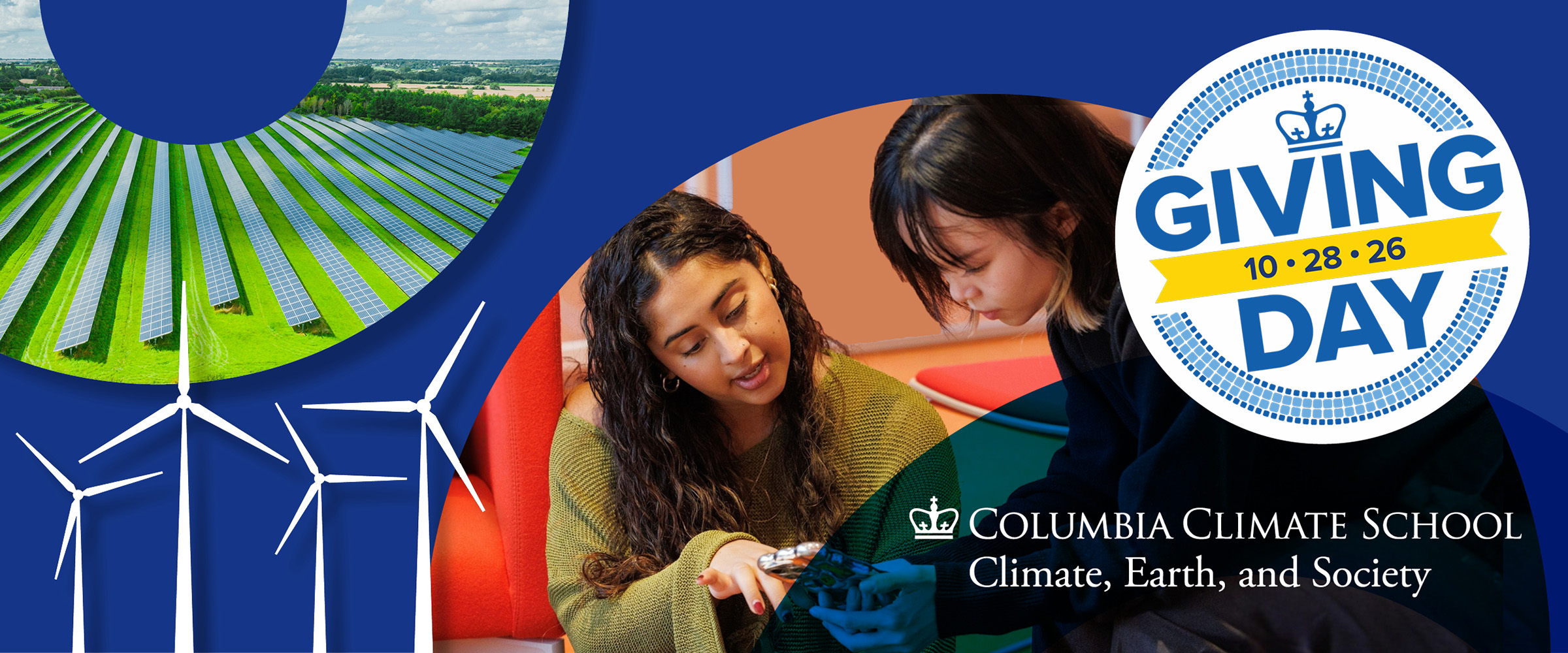
Columbia Climate School Giving Day on October 28, 2026, featuring students and renewable energy imagery

October 28, 2026 is Columbia Giving Day! Your gift to Columbia Climate School helps advance interdisciplinary research, educate the next generation of leaders, and transform bold ideas into real-world solutions for climate, Earth, and society.

  • Master of It All: One Woman Scientist Pays Tribute to Another

    Master of It All: One Woman Scientist Pays Tribute to Another

    Lamont-Doherty geophysicist Robin Bell pays tribute to colleague Kim Kastens who is retiring from Lamont after 31 years. Kastens was the first woman co-chief scientist on the JOIDES Resolution, first woman faculty member to join Columbia’s geology department, founder of Columbia’s joint journalism and environmental science master’s program and a pioneer in the field of…

  • Polar Climate Change Education Partnership Receives $5.6 Million Grant

    Polar Climate Change Education Partnership Receives $5.6 Million Grant

    The Columbia Climate Center led PoLAR Climate Change Education Partnership receives a $5.6 million grant from the National Science Foundation (NSF), one of six awards under the Climate Change Education Partnership-Phase II program.

  • Education for Sustainable Citizenship

    Education for Sustainable Citizenship

    UNESCO Director General Irena Bokova said sustainable development cannot be achieved by political agreements, financial incentives or technological solutions alone. There must be a fundamental change in the ways individuals think and act.

  • Students. Saturday. Science?

    It’s a Saturday morning, and most kids between the ages of 12 and 14 are sleeping in, off to rehearsals or sports team practice, or grudgingly helping with household chores. At Columbia University, a group of middle-school students are eagerly engaging in the scientific method.

  • From Brazil to Jordan: Columbia Undergrads Learn about SEE-U’s Summer Fieldwork Programs

    Undergraduate students learn about summer field opportunities in Jordan, the Dominican Republic and Puerto Rico offered through the Summer Ecosystems Experience for Undergraduate (SEE-U) program at Columbia.

  • An Interactive Map of Scientific Fieldwork

    An Interactive Map of Scientific Fieldwork

    Earth Institute scientists explore how the physical world works on every continent — over and under the arctic ice, in the grasslands of Mongolia, on volcanoes in Patagonia, over subduction zones in Papua New Guinea, and on the streets of New York City.

  • From Sendai to Rio: A Call for Action

    From Sendai to Rio: A Call for Action

    The people living on the northeast coast of Japan had learned to expect large earthquakes. But despite being one of the best-prepared nations, they were caught off-guard by the force of the March 11, 2011, earthquake and tsunami that devastated their coastline and led to the meltdown of reactors at the Fukushima nuclear power plant.

  • Composter Puts College Food Waste in Its Place

    Composter Puts College Food Waste in Its Place

    Columbia has welcomed a composting machine to campus, a first at a New York City university. Accepting food scraps, such as banana peels, coffee grounds and egg shells, the composter will provide a way to recycle the urban campus’s food waste while also serving as an educational tool.

  • Carbon Management Distinguished Speaker Series

    Carbon Management Distinguished Speaker Series

    The Earth Institute’s Columbia Climate Center presents “Managing Carbon on Land in the Context of Climate Change,” with Richard Houghton, Senior Scientist, Woods Hole Research Center as part of a new Carbon Management Distinguished Speaker Series.