Earth Sciences51
-
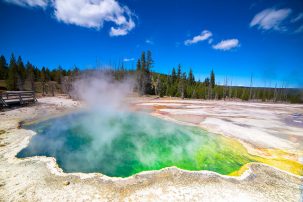
What Is a Supervolcano, and Should You Really Be Worried About the One at Yellowstone?
Despite recent media reports, there’s no imminent threat, says Columbia geologist Einat Lev.
-

Ancient Humans Left Africa to Escape Drying Climate, Says Study
Ancient humans migrated out of Africa to escape a drying climate, says a new study—a finding that contradicts previous suggestions that ancient people were able to leave because a then-wet climate allowed them to cross the generally arid Horn of Africa and Middle East.
-

Study Bolsters Volcanic Theory of Ancient Extinction
A team of scientists has found new evidence to bolster the idea that the Permian Extinction, which occurred 252 million years ago, was caused by massive volcanic eruptions in what is now Siberia.
-

Photo Essay: Climate Change, Sea Level and the Vikings
A thousand years ago, powerful Viking chieftans flourished in Norway’s Lofoten Islands, above the Arctic Circle. In an environment frequently hovering on the edge of survivability, small shifts in climate or sea level could mean life or death. People had to constantly adapt, making their living from the land and the sea as best they…
-

What the Vikings Can Teach Us About Adapting to Climate Change
The rise of the Vikings was not a sudden event, but part of a long continuum of human development in the harsh conditions of northern Scandinavia. How did the Vikings make a living over the long term, and what might have influenced their brief florescence? Today, their experiences may provide a kind of object lesson…
-

‘Pangeo’ Project Will Improve Access to Climate Data
The better climate models become, the harder it is to use them. One team of researchers is working to fix that.
-

East Antarctic Ice Sheet Should Remain Stable Even if the West Melts
A new look inside the ice sheet validates predictions that it probably won’t melt as quickly as its neighbor—good news, since East Antarctica contains enough water to raise sea levels by 200 feet.
-

Antarctic Ice-Mapping Project Will Fly for the Last Time in October
With its mission complete, the Rosetta-Ice Project will give scientists an unprecedented look at the Ross Ice Shelf and how it’s changing with the climate.
-

How Will Climate Change Impact Shelter?
In this video, Lamont-Doherty Earth Observatory researchers Robin Bell, Radley Horton, and Adam Sobel explain their research and how it can help improve adaptation practices and make our homes, livelihoods, and the systems we rely on more resilient to extreme weather and sea level rise.


The first Earth Day in 1970 ignited a movement to stop polluting our planet. Today, our scientists and experts are tackling the most pressing challenges to achieve real-world impact. This Earth Day, join us in our commitment to realizing a just and sustainable future for our planet. Visit our Earth Day website for ideas, resources, and inspiration.
