Earth Sciences85
-

The Long Life of Death Valley
Geologist Nicholas Christie-Blick has studied the Death Valley region for more than four decades. Each spring, he leads a group of Columbia University undergraduates there on a fieldtrip. Check out highlights from this year’s trip.
-

Deep Sea Plough
Giant fleets the oceans trawl, Gasping fish they skywards haul. Not just critters do they move, But sediments they push and groove …
-

Solving the Mysteries of Carbon Dioxide
About 50 percent of the CO2 produced by human activity remains in the atmosphere, warming the planet. But scientists don’t know where and how oceans and plants have absorbed the rest of the manmade CO2. To try to answer these questions, on July 2, 2014, NASA launched the $468 million Orbiting Carbon Observatory-2 (OCO-2), its…
-

Investigating Water Quality and Arsenic in Bangladesh
Postcard from the Field: Lamont-Doherty Earth Observatory graduate student Rajib Mozumder, who works with Lamont scientists Lex van Geen and Ben Bostick, has spent part of his summer drilling water wells and collecting samples in Bangladesh.
-

A ‘Bumper-Car’ Ride in the Ice Mélange
Today’s plan is to extend the sampling to include a wider region of the water exchange between Alison (Nanatakavsaup), the surrounding ocean and the connection to Hayes glacier. At the Village Meeting we had queried the local fisherman about the iceberg exit pathways for both Alison and Hayes to confirm or correct information we have…
-

World Trade Center Ship Traced to Colonial-Era Philadelphia
Four years ago this month, archeologists monitoring the excavation of the former World Trade Center site uncovered a ghostly surprise: the bones of an ancient sailing ship. In a new study, scientists at Lamont-Doherty Earth Observatory say that an old growth forest in the Philadelphia area supplied the white oak used in the ship’s frame,…
-

View from an Iceberg
The science goal for today is to complete 8 CTD casts. We load into our vessel, a Poca 500GR. We have discussed a 6 to 8 hour window of boat time with Gabriel the captain and Magnus our navigator and stocked up on 40 liters of benzene.
-

A Meeting for the Kullorsuaq Community
It seems that many of the local fishermen have gone to hunt Narwal further north but there are several good prospects for boats that Søren will scout further as several of the fishermen are sleeping as the fishing is better right now at night. With 24 hours of daylight day or night fishing doesn’t really…
-

‘Thumbs Up’ for Travel to Kullorsuaq
At the small airport a smiling woman approaches us asking our plans in one word “Kullorsuaq?” We smile and nod and she grins broadly motioning that she and her daughter are going there too – it is their home she manages to convey.


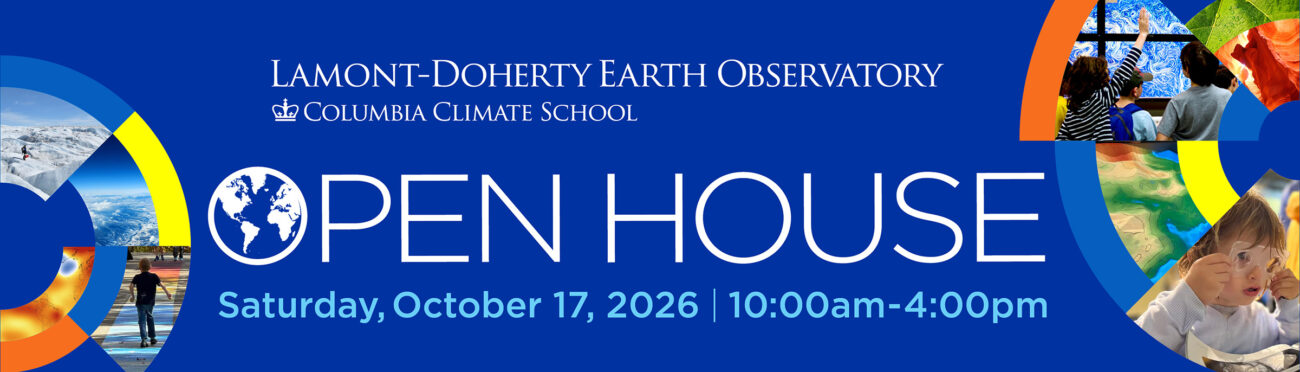
On Saturday, October 17, 2026 from 10am to 4pm, Lamont-Doherty Earth Observatory Open House—our biggest, best science fun and discovery event of the year—will take place on our beautiful campus in Palisades, NY. Mark your calendar and join us for this free, family-friendly celebration of science! RSVP Today!
