Arctic
-
October Research Roundup: Select Papers
In this month’s research roundup, we explore how delayed climate action could trigger abrupt changes in the Arctic; what ancient ocean sediments reveal about carbon storage during the last ice age; how fiber-optic cables are improving earthquake monitoring at geothermal sites; and a new timeline of Earth’s magnetic reversals.
-
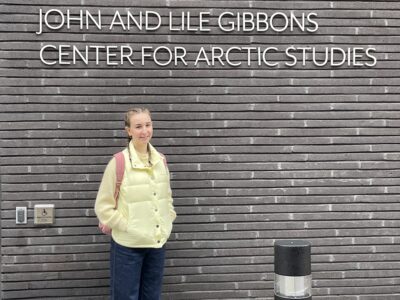
A Polar Climate Ambassador Visits an Arctic Museum in Maine
Josie Brooks reflects on an exhibit at Maine’s Peary-MacMillan Arctic Museum, which explores Inuit food traditions, hunting, art and community.
-

A Composer’s Instrumental Ode to the Arctic Circle
Environmental sound artist Mary Edwards turns field recordings of glacial phenomena in Svalbard into a collaborative musical performance.
-

Why Care About the Polar Regions? These Polar Climate Ambassadors Will Tell You.
The polar regions are a critical aspect of the climate crisis, but polar science is not always accessible, especially to young students. The Polar Climate Ambassadors program seeks to help close this gap.
-

Montreal Protocol Is Delaying First Ice-Free Arctic Summer
New research from Columbia climate scientists shows that the 1987 ozone treaty, designed to protect the ozone layer, has postponed the occurrence of the first ice-free Arctic by as much as 15 years.
-

A Hidden World: Nighttime Photography in Greenland
Photographer Steven Giovinco shared his thoughts on the creative process behind his images on display in a new exhibition, ‘On The Arctic Edge’.
-

More Frequent Atmospheric Rivers Are Hindering the Recovery of Arctic Sea Ice
Giant trains of warm, moist air are playing havoc with Arctic sea ice during the season when it should be recovering from summer melting.
-

Permafrost Emissions Must Be Factored Into Global Climate Targets, Says Study
As the Arctic melts, permafrost there has the potential to send huge amounts of carbon into the atmosphere, but exactly how much is up for grabs, depending on what we do to stem climate change in coming years.
-

How Is Climate Change Affecting Ocean Waters and Ecosystems?
Biological oceanographer Hugh Ducklow describes decades of work in far-flung places to understand the evolving ecology of the oceans. The picture is not always clear.



COP31, the 2026 United Nations Climate Change Conference, aims to advance dialogue, strengthen consensus, and accelerate climate action on a global scale. From November 9–20, 2026 in Antalya, Türkiye, heads of state, ministers, scientists, business leaders, and civil society will gather to advance efforts in emission targets, climate finance, and adaptation and resilience. Once again, our experts, students, and global thought leaders from Columbia Climate School and across Columbia University are contributing to key events, sharing insights, and helping shape the dialogue toward ambitious, science-based solutions. Learn More
