Earthquakes3
-
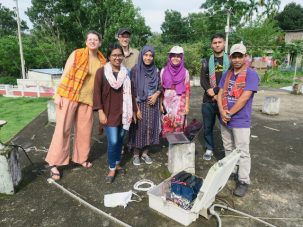
Start of the Mini-Field School
We were joined in our electromagnetic investigation of the subsurface and earthquake hazard by a group of US and Bangladeshi students and professors for a mini-Field School.
-

Tea Gardens to the Rescue
We switched to deploying our equipment for imaging faults and the structure beneath the surface to tea gardens to get away from power lines and buried the cables to protect them from gnawing foxes.
-

Dealing With Rain and Rats
As we continued our geophysical measurements, we had to deal with heavy rains, flooding fields, and rats and foxes biting our cables. Many cables were broken soon after sunset, ruining the measurements.
-

Fieldwork in Bangladesh During the End of Ramadan and Eid Festival
We have come to in Bangladesh in the pre-monsoon heat to better image the active faults beneath the surface using electromagnetic instruments. We are using the fallow fields from the just-harvested rice crop for our sites.
-

The Matterhorn: Alive With Vibrational Energy
In a recent study, researchers found that the Matterhorn is constantly swaying to the seismic energy of earthquakes and ocean tremors felt around the world.
-

A Slow-Motion Section of the San Andreas Fault May Not Be So Harmless After All
The central section of the great fault spanning California, thought to be creeping along harmlessly at the moment, has experienced big quakes in the past, says a new study.
-

Return of the R/V Pelican to Ocho Rios, Jamaica
The expedition discovered stresses along an underwater plate boundary and a record of historic and pre-historic earthquakes, which will shed light on the geohazard risks for Jamaica and Haiti.
-

Looking at the Seafloor Without Water
Along the Enriquillo fault, large-scale submarine landslides provide possible evidence of earthquakes.
-

Mapping Offshore Faults in Kingston Bay
Motion along these faults is associated with the 1907 Kingston earthquake, which shook the capital of the island with a magnitude of 6.2


The first Earth Day in 1970 ignited a movement to stop polluting our planet. Today, our scientists and experts are tackling the most pressing challenges to achieve real-world impact. This Earth Day, join us in our commitment to realizing a just and sustainable future for our planet. Visit our Earth Day website for ideas, resources, and inspiration.
