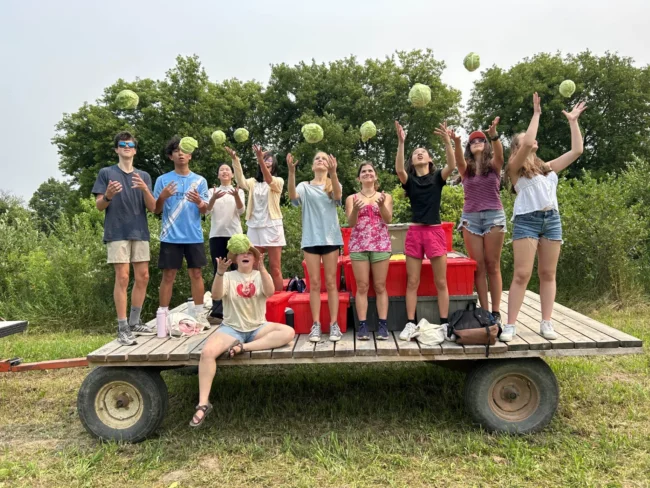
Every July since 2021, Vermont State University’s Castleton campus, seven miles east of the New York/Vermont border, welcomes Columbia Climate School faculty, Putney Student Travel facilitators and a cohort of high school students from around the world to study climate for an intensive two weeks. This summer was the sixth year of the program, bringing in 58 students from the United States, China, Hong Kong, Thailand, Singapore and the U.K. Throughout the program, students learn directly from Climate School faculty and local climate leaders and engage in hands-on fieldwork, all with the goal of empowering students with the necessary skills to lead climate action in their own communities.
Led by Laurel Zaima-Sheehy, associate director of pre-college and partner programs at the Columbia Climate School, and supported by Emma Kyzivat, the Green Mountains graduate student program assistant, the program brought six additional Climate School experts to Castleton to teach sessions related to climate science and modeling, disaster management, international climate policy and the circular economy. The program began with a session focused on the importance of youth climate action led by Zaima-Sheehy, before students began two full days focused on the science of climate change, led by Aandishah Tehzeeb Samara and Alex Parsells, Ph.D. candidates in the Department of Earth and Environmental Sciences at Columbia University. Highlights included hands-on demonstrations of key climate science concepts, including “solar radiation tag” to illustrate the greenhouse effect, a climate symphony demonstrating climate variability across different timescales, and rotating-tank experiments illustrating baroclinic instability.

Following the climate science sessions, Josh DeVincenzo, assistant director for education and training at the National Center for Disaster Preparedness at the Columbia Climate School, returned for his sixth year to lead sessions focused on disaster preparedness tools and strategies for effective climate communication. Students practiced difficult climate conversations through role-play scenarios with an AI climate skeptic bot trained to present some of the most common arguments and misconceptions raised by climate change doubters.
After DeVincenzo’s sessions, students participated in a full-day excursion to the Vermont State House in Montpelier. There, students met with Vermont state representatives who shared their experiences working at the intersection of climate and politics, and led meaningful conversations around Vermont’s role in the larger climate movement. This excursion sparked curiosity and rich conversations around the role of policymakers in climate action, and was followed by two full days of climate policy and decarbonization sessions led by Martin Dietrich Brauch, lead researcher at the Columbia Center on Sustainable Investment (CCSI), and Ben Baraga, program associate at CCSI. A highlight of the Green Mountains Program is the Conference of the Parties (COP) simulation that students engage in as the culminating activity for the climate policy sessions. Students are divided into negotiating blocs representing those at the annual COP and gain exposure to the difficult conversations and decisions that must be made with regard to climate action at the international level.

In the final days of the program, Sandra Goldmark, associate dean of the Office of Engagement and Impact at the Climate School, led students through an interactive Shark Tank-inspired activity focused on rethinking linear systems. Students developed creative circular models for traditionally linear systems, such as the textile industry, food waste, technology, and school products. During the final day of academic programming, Kyzivat led a session focused on envisioning a just and sustainable future. Students were introduced to the work of climate activists from around the world and then had time to explore climate justice solutions through the Solutions Project storybank. In addition to the rich expertise shared by Columbia Climate School experts, students also gained hands-on experience with fieldwork and data collection, including taking tree cores, surveying macroinvertebrates and collecting water samples from nearby Lake Bomoseen.

The core component of the Green Mountains program is an individual Climate Action Project (CAP) that students develop throughout the two weeks and present to the cohort on the final day. The CAPs challenge students to identify a need within their community and apply what they have learned in the program to create a unique climate action project to bring home. This year, student CAPs ranged from school composting initiatives to textile circularity programs, green infrastructure initiatives, climate education through school programming, website creation and climate comics, and goat grazing as a form of wildfire resiliency. These projects offer a strong foundation for impactful climate action, with many alumni expanding their project scope over time and collaborating with other young climate activists to amplify impact. This summer, Anna Panjwani, a 2024 alumna of the program, returned as a keynote speaker to discuss how her project had grown and the role the program played in her academic and professional journey. After the program, students are encouraged to stay connected and share the progress of their CAPs through an alumni network group.

The rigorous academic experience provided by the Columbia Climate School in the Green Mountains creates a safe space for students to grow intellectually, but it also fosters lasting friendships. In a post-program evaluation, one student noted, “My favorite part was collaborating with peers from different regions to design community climate solutions together. During group discussions and presentation practices, we exchanged unique local environmental challenges and creative countermeasures. I not only mastered systematic methods to develop feasible urban climate action plans, but also built sincere friendships with like-minded partners who share the same passion for environmental protection.” By blending hands-on learning with cross-cultural collaboration, the program equips the next generation of climate leaders with networks and problem-solving skills necessary to drive impactful climate action worldwide.
For more information about the Columbia Climate School in the Green Mountains program, please explore our website and FAQs. Sign up here for our pre-college mailing list to stay updated on summer and academic year offerings, or email us at learn@climate.columbia.edu.